Scale Consult personnel have more than 20 years of experience with MEG systems, MEG chemistry, and MEG processing. We have a unique understanding of the chemistry of MEG loops, operation strategies, key monitoring parameters, and optimisation of MEG loops and MEG regeneration/reclamation processes.
ScaleSim™ software has a MEG module specialised for simulating chemistry in MEG systems and how MEG influences salt solubility and scale risk.
Scale Consult can help with:
Design of MEG loops and MEG processes (MEG regeneration and reclamation)
Operation strategies for MEG loops and fields with continuous MEG injection
Setting up sampling/monitoring programmes for MEG loops
Simulating chemistry of MEG loops, including scale potentials, salt precipitation, pH levels, organic acid accumulation, etc.
Troubleshooting MEG processes that do not work as intended
Challanges in MEG systems
Mono Ethylene Glycol (MEG) is used to prevent formation of gas hydrates in both pipelines and processes. A typical application is for long transport pipelines from offshore producers with tie-backs to an onshore (or offshore) process plant. As the gas/condensate cools down, water will condense and form an aqueous phase. To prevent hydrate formation, MEG is injected at the pipeline inlet and mixes with water inside the pipeline to prevent hydrate formation.
At the process facility, the water-MEG mixture (called Rich MEG) is separated from the gas/condensate and distilled to regenerate high-concentration MEG (called Lean MEG). This is called MEG regeneration. The lean MEG is then pumped via separate pipelines back to the injection point. This cycle is often referred to as the MEG loop.
If formation water (containing various ions and salts) is produced into the MEG loop, the rich MEG will be contaminated with salts. These salts will not be removed by distillation and will accumulate in the MEG loop. Eventually, they will precipitate and can form scale. To remove salts from the MEG, a reclamation process is necessary.
MEG changes the chemistry—it alters salt solubility, gas solubility, and pH. With the MEG module in ScaleSim, we can simulate the chemistry of MEG loops:
How MEG influences scale potentials
How salts accumulate in a MEG loop and where they can form scale
The effect of adding pH stabilisers and how they influence pH and scale potentials
MEG regeneration and reclamation processes, determining minimum required reclamation rates to avoid salt precipitation in the MEG loop.
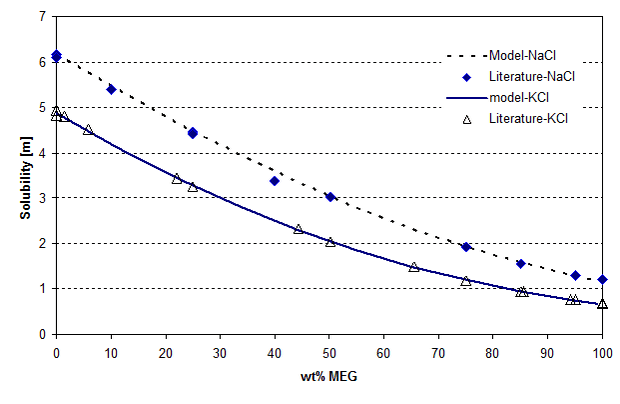
Measured and simulated solubility of NaCl and KCl in water-MEG mixtures.
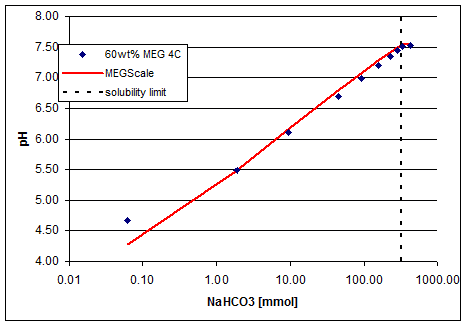
Measured and simulated pH in Rich MEG at 4°C as function of pH stabilizer concentration.
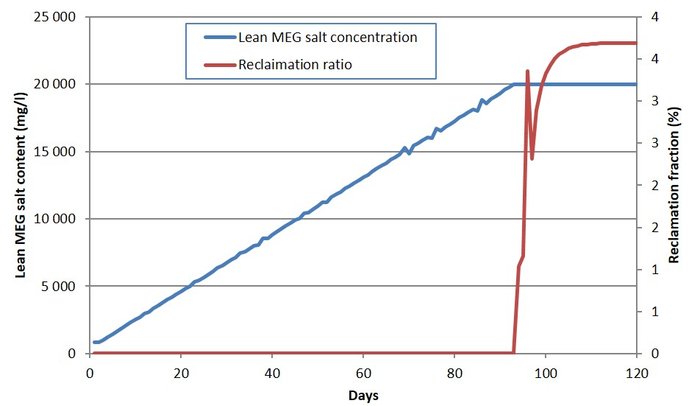
Accumulation of salt in a MEG loop without reclaimer in operation, and then startup of reclaimer to keep salt content below 20 000 mg/l.